
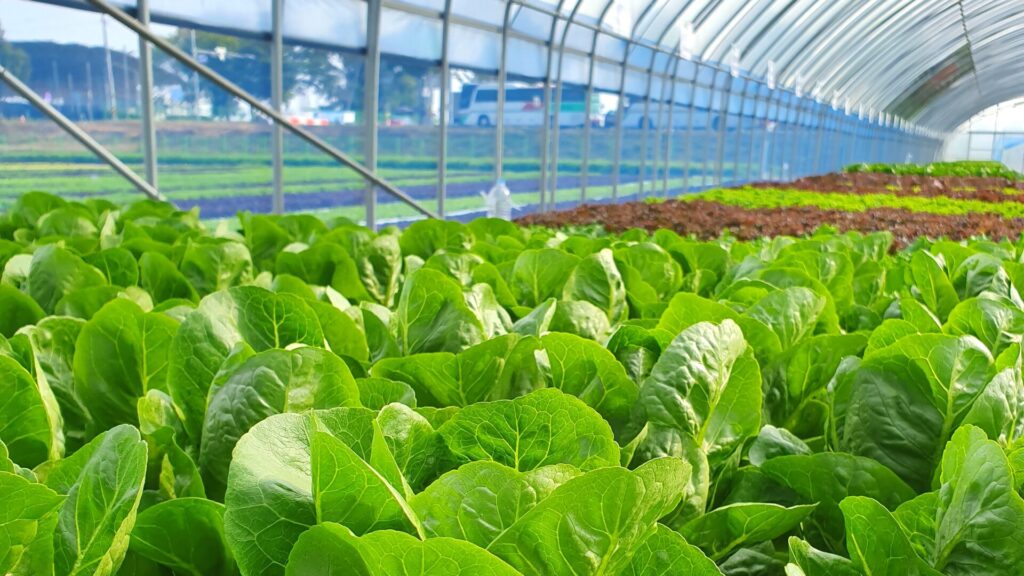
Summary of Plant biostimulants from seaweeds or vegetal proteins enhance the salinity tolerance in greenhouse lettuce by modulating plant metabolism in a distinctive manner
Biostimulant Effects on Greenhouse Lettuce Under Salinity Stress
Biostimulant Effects on Greenhouse Lettuce are increasingly studied as sustainable solutions to improve crop performance under stress conditions. In greenhouse systems, salinity represents a major constraint for lettuce growth and yield. Therefore, growers and researchers seek effective tools to reduce salt-related damage while maintaining productivity. Among these tools, plant biostimulants such as seaweed extracts (SWE) and protein hydrolysates (PH) show promising results.
This study evaluates how these biostimulants influence greenhouse lettuce growth, yield, mineral composition, and metabolic responses under both optimal and saline conditions.
Biostimulant Effects on Greenhouse Lettuce Growth and Yield
Salinity stress strongly reduced lettuce growth. In fact, shoot fresh weight decreased by 15.3% at 40 mM NaCl. However, biostimulant application significantly improved plant performance.
Both SWE and PH increased shoot fresh weight under non-saline conditions. Moreover, their effects were even stronger under salinity stress. On average, yield increased by 18% when plants received biostimulant treatments. These results clearly demonstrate positive biostimulant effects on greenhouse lettuce productivity.
Effects of Biostimulants on Mineral Uptake in Greenhouse Lettuce
Salinity usually causes excessive sodium and chloride accumulation in plant tissues. Consequently, nutrient balance becomes disrupted. In this study, biostimulants actively reduced ion toxicity.
PH reduced sodium content by 15.6% under saline conditions. Similarly, SWE lowered sodium accumulation by 9.4%. Additionally, PH significantly decreased chloride concentration, while SWE showed a weaker effect. Therefore, PH appeared more effective in regulating harmful ion uptake.
Biostimulant Effects on Greenhouse Lettuce Metabolism
Beyond growth responses, biostimulants also altered lettuce metabolism. Both SWE and PH triggered strong metabolic reprogramming. As a result, plants accumulated stress-related compounds.
Notably, glucosinolates, jasmonates, and terpenoid phytoalexins increased following biostimulant application. However, the two products acted differently. PH promoted glucosinolate and phytoalexin precursor accumulation. In contrast, SWE reduced the accumulation of several secondary metabolites under salinity stress.
These distinct metabolomic signatures highlight different modes of action. Therefore, combining both biostimulants could offer complementary benefits.
Implications for Sustainable Greenhouse Lettuce Production
Overall, this research confirms the strong biostimulant effects on greenhouse lettuce under saline conditions. SWE and PH enhanced yield, improved mineral balance, and activated stress-related metabolic pathways. Moreover, their distinct physiological responses suggest possible synergistic strategies.
Consequently, integrating targeted biostimulant applications into greenhouse systems may help mitigate salinity stress. This approach supports sustainable lettuce production while maintaining high yield and quality.
Publication: Scientia Horticulturae